Agricultural Harvester Vector Illustrations: A Practical Asset for Modern Design Projects
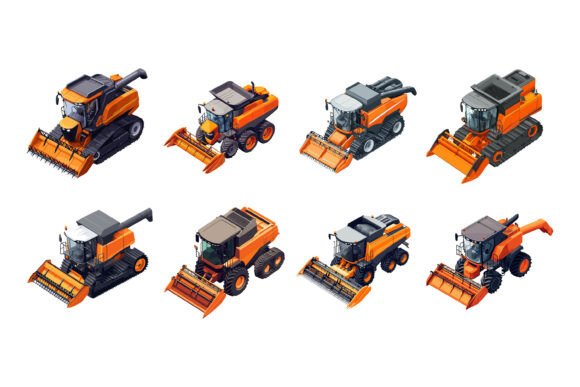
Finding reliable, well-structured illustration sets for agricultural themes can take more time than the actual design work. The Agricultural Harvester AI EPS collection addresses this by offering a focused set of vector graphics built specifically around harvesting equipment and related machinery. For designers, marketers, and content creators working in agriculture-adjacent fields, having access to clean, editable illustrations of combine harvesters, tractors, and associated equipment solves a recurring resource problem.
What sets this particular collection apart is not the subject matter alone, but the attention given to file organization and cross-platform compatibility. Many stock illustration packs arrive as a flat folder of loosely named files with inconsistent styling. This collection takes a different approach, with neat layer structures and file formats that work across both Mac and Windows environments without conversion headaches.
What the Agricultural Harvester Collection Includes
The download package contains three core file formats: AI (Adobe Illustrator), EPS (Encapsulated PostScript), and JPG. The AI and EPS versions provide fully vector-based artwork, meaning illustrations remain sharp at any scale—from a small website icon to a large trade show banner. The JPG versions offer quick-access raster files for projects where vector editing is unnecessary, such as blog posts, presentations, or social media graphics.
Each illustration within the collection is built with organized layers, which means you are not dealing with flattened, uneditable artwork. You can isolate specific components of a harvester illustration, adjust stroke weights, swap colors, or remove background elements without reconstructing the entire graphic. This level of editability matters when you need to match brand colors or adapt an illustration to fit a specific layout.
Practical Applications Across Industries
Agricultural harvester illustrations serve a broader range of users than one might initially assume. The obvious audience includes agricultural equipment dealers, farming cooperatives, and agribusiness companies needing visuals for brochures, websites, and instructional materials. But the usefulness extends further.
Marketing agencies handling agribusiness clients often struggle to find consistent, professional-grade vector art that does not look generic or cartoonish. This collection provides a unified visual style, which is valuable when building out a brand identity system or a multi-page publication where illustrations must feel cohesive from start to finish.
Educators and publishers producing agricultural textbooks, training manuals, or e-learning modules can use these illustrations to explain harvesting processes, machinery components, or farm operations. Because the files are vector-based, they can be enlarged for classroom posters or reduced for worksheet diagrams without quality loss.
Infographic designers and data visualization specialists working on agricultural reports, sustainability studies, or food supply chain content will find the icon-level suitability useful. Clean harvester silhouettes and detailed machinery illustrations can act as visual anchors in otherwise data-heavy layouts. The ability to modify colors means the illustrations can adapt to any color scheme rather than forcing the designer to compromise on palette.
App and web developers building agricultural tools, farm management platforms, or equipment marketplaces can integrate these illustrations as UI elements, onboarding graphics, or feature icons. The EPS and AI formats ensure compatibility with development workflows that require vector source files.
File Structure and Cross-Platform Reliability
One aspect that deserves specific mention is the stated cross-platform support for both Mac and Windows users. Design teams are often split across operating systems, and nothing disrupts a workflow faster than a file that opens correctly on one machine but breaks on another. The EPS format, in particular, serves as a reliable interchange format that maintains vector data and editability across different design applications, including Adobe Illustrator, Affinity Designer, CorelDRAW, and open-source alternatives like Inkscape.
The organized file and layer structure reduces the time spent deciphering someone else's messy construction. When you open a file and find clearly named layers, grouped objects, and logical stacking order, you can begin editing immediately rather than untangling a web of unnamed paths. This is a practical quality-of-life feature that experienced designers appreciate because it directly affects project turnaround time.
Detail Consistency and Professional Finish
Perfection in details and consistency, as noted in the collection's description, is not merely marketing language when it comes to vector illustration sets. What it means in practice is that all illustrations within the pack share the same line weight treatment, the same approach to shading and highlights, and the same level of geometric precision. There are no jarring style shifts from one harvester illustration to the next.
This consistency is especially important for multi-illustration projects. Imagine an equipment catalog featuring ten different harvester models. If each illustration looks like it came from a different artist, the publication feels unpolished. A consistent set eliminates that problem before it starts. The visual language remains uniform, which reinforces the professional credibility of the final product—whether that product is a printed catalog, a digital presentation, or an interactive application.
Detail work on machinery illustrations carries particular weight. Harvesters are complex machines with visible mechanical components, grain tanks, headers, wheels or tracks, and operator cabs. Illustrations that capture these elements accurately, with proper proportions and recognizable part relationships, communicate competence. Oversimplified or anatomically incorrect machinery illustrations can undermine the authority of the content they accompany, especially when the audience includes people who work with this equipment daily.
Editing Flexibility and Customization
The ease of editing vector files is a primary reason designers choose AI and EPS formats over raster alternatives. With these agricultural harvester illustrations, you can change fill colors, adjust stroke properties, scale individual elements, and combine components from different illustrations within the set. Need to recolor a green harvester to match a specific manufacturer's branding? That is a straightforward fill adjustment rather than a pixel-level recoloring job in Photoshop.
This flexibility supports rapid prototyping and iteration. A marketer preparing campaign visuals can experiment with different color treatments, overlay text, or integrate the harvester illustration into a larger composition without committing to a final version too early. The non-destructive nature of vector editing means the original artwork remains intact, ready for the next variation or the next project.
The collection is also described as suitable for infographics, which implies that the illustrations work at smaller scales where clarity is essential. Infographic icons need to read clearly at sizes where pixel-based images would blur or lose definition. Vector-based harvesters maintain crisp edges and recognizable silhouettes even when reduced to icon dimensions.
Who Gains the Most From This Collection
Graphic designers working on agricultural branding projects will likely see the most immediate return. Having a ready-to-use set of harvester illustrations means less time tracing photographs or hunting through stock sites for individually licensed images that may not match stylistically. The collection functions as a visual system rather than a random assortment.
Small business owners in the agricultural sector—including equipment resellers, repair services, and farm supply stores—can use these illustrations to elevate their marketing materials without hiring a custom illustrator. The editable nature of the files means even someone with basic Inkscape or Illustrator skills can make adjustments, while professional designers can dive deeper into customization.
Content creators and bloggers covering farming technology, agricultural machinery reviews, or harvest season topics can incorporate the illustrations as header images, article accents, or social media thumbnails. The JPG format provides a quick-access option for these use cases, while the vector originals remain available for more polished applications.
Educators developing agricultural science curriculum materials benefit from having accurate, detailed machinery illustrations that students can examine. The ability to isolate and label components makes these files useful for creating diagrams, worksheets, and assessment materials.
Realistic Considerations and Limitations
No resource fits every scenario perfectly, and it is worth considering what this collection does and does not provide. The illustrations are focused on agricultural harvesters, which means the scope is specific. If your project also requires illustrations of planting equipment, irrigation systems, or livestock handling facilities, you will likely need additional resources or complementary illustration sets to cover those subjects.
The quality of the illustrations depends on the original artist's understanding of harvester design and mechanical accuracy. Professionals working in agricultural equipment manufacturing may have higher standards for technical precision than a general designer. It is advisable to review the preview images carefully if your use case demands exact mechanical representation, such as service manuals or parts catalogs where dimensional accuracy matters.
The collection's value also correlates with how frequently you need harvester imagery. For a one-time project, the investment might feel heavier than for a designer who regularly produces agricultural content. Consider your volume of agriculture-related work when evaluating whether a dedicated harvester illustration set makes sense for your asset library.
Long-Term Value in a Design Asset Library
Vector illustration sets tend to age better than raster alternatives because resolution independence never goes out of style. A well-built AI or EPS file created today will remain usable years from now, across software updates and screen resolution improvements. The cross-platform compatibility adds further longevity, as the files are not locked to a specific operating system or application ecosystem.
For teams and freelancers who maintain asset libraries for recurring client work, adding a consistent set of agricultural harvester illustrations reduces future sourcing time. Rather than starting from scratch on each agriculture-related brief, you can pull from pre-vetted, editable assets that you already understand.
The organized layer structure also supports future-proofing. Even if you hand off a project to another designer, clearly structured files reduce the onboarding friction that comes with inheriting someone else's working documents. This is a subtle but real efficiency gain in collaborative environments.
Making an Informed Decision
Before adding any illustration collection to your toolkit, assess your actual needs. If agricultural harvesters appear regularly in your work—whether in marketing collateral, educational content, digital products, or editorial illustrations—this collection addresses a specific gap that generic stock libraries often fill poorly. The combination of vector editability, organized file architecture, and cross-platform support makes it a practical resource rather than a novelty.
For those whose work occasionally touches on agriculture but does not justify a dedicated harvester illustration set, the individual-use licensing model typical of such collections means you can still access the files without a subscription commitment. The key consideration is whether the consistency, editability, and subject-matter focus align with the projects you actually deliver.
The agricultural harvester AI EPS collection represents a focused solution for a specific visual communication need. Its practical value lies in the time it saves, the professional finish it enables, and the creative flexibility it offers across print, web, and interactive media projects.