Alien Sci-fi Insect Illustrations — A Complete Guide for Designers and Creators
In the ever-expanding universe of digital design resources, Alien Sci-fi Insect illustration sets have carved out a distinctive niche that appeals to designers working across genres ranging from speculative fiction to cutting-edge branding. These otherworldly creatures blend the familiar anatomical logic of terrestrial insects with the imaginative freedom of science fiction, resulting in visual assets that feel simultaneously unsettling and captivating. Whether you are developing a video game concept, crafting an infographic about hypothetical ecosystems, or designing promotional materials for a tech startup that wants to project an edgy, futuristic identity, understanding what makes these Alien Sci-fi Insect collections valuable can help you make informed decisions about your creative toolkit.
What Exactly Is an Alien Sci-fi Insect Illustration Set?
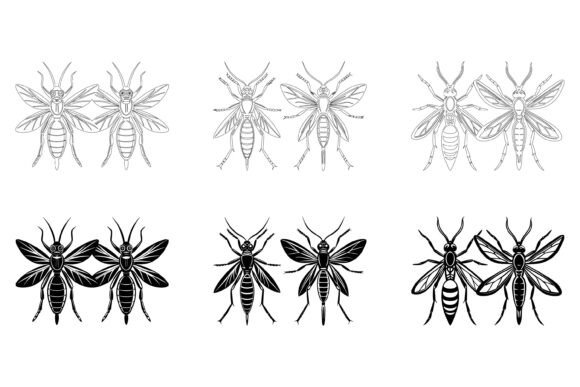
An Alien Sci-fi Insect illustration set is a curated collection of vector-based artwork depicting insect-like creatures imagined through the lens of speculative biology and futuristic design. Unlike standard entomological illustrations that prioritize scientific accuracy, these sets push boundaries by incorporating metallic exoskeletons, bioluminescent appendages, extra limbs, unnatural color palettes, and anatomical configurations that defy Earth-based taxonomy. The creatures might resemble a hybrid of a praying mantis and a mechanical drone, or a beetle whose carapace doubles as a solar array. The unifying thread is that each design feels plausibly organic while remaining unmistakably extraterrestrial.
The file formats typically included — AI, EPS, and JPG — ensure broad compatibility across design ecosystems. The native Adobe Illustrator format preserves full editability, allowing you to manipulate every anchor point and bezier curve. EPS files serve as a universal exchange format that integrates smoothly into older software or workflows that demand encapsulated PostScript. The included JPG previews offer quick reference thumbnails without the overhead of opening vector applications. Importantly, these collections are designed for both Mac and Windows users, removing the friction that sometimes accompanies cross-platform collaboration.
Why Working Professionals Keep Returning to These Collections
Designers who have spent years navigating disorganized asset libraries understand the quiet frustration of downloading a promising file only to find layers named "Layer 1," "Layer 2," and "Path 42." The Alien Sci-fi Insect illustration sets distinguish themselves through neatly organized file and layer structures. Each creature, appendage, and decorative element resides on a clearly labeled layer, often grouped logically by body region or functional system. This organizational discipline might sound minor, but for a designer working against a tight deadline, the ability to isolate a creature's wing membrane for recoloring without accidentally selecting its thorax can save precious minutes that compound into hours over the course of a project.
The emphasis on perfection in details and consistency further elevates these collections above generic stock illustrations. When you examine a quality Alien Sci-fi Insect set, you will notice that the line weights remain uniform across the entire series, the lighting direction on highlights and shadows follows a consistent source, and the level of intricacy does not abruptly drop from one creature to the next. This cohesion matters immensely when multiple illustrations appear together in a single layout — imagine a field guide to alien fauna where one entry looks photorealistic while another resembles a rough sketch. Consistency ensures that your final composition reads as a unified vision rather than a patchwork of disparate assets.
Practical Applications Across Industries
The versatility of Alien Sci-fi Insect illustrations extends far beyond the obvious use case of science fiction book covers. Consider the following real-world scenarios where these assets have proven unexpectedly valuable:
- Educational Infographics: Biology educators teaching concepts like adaptation and convergent evolution can use stylized alien insects to illustrate principles without students bringing preconceptions about familiar Earth species. A hypothetical creature with heat-dissipating wing structures makes the concept of thermoregulation tangible and memorable.
- App Iconography: Mobile applications in the gaming, meditation, or creative tools space often seek distinctive icon designs that stand out on crowded home screens. An Alien Sci-fi Insect silhouette, simplified and recolored for small-scale legibility, can provide that memorable visual hook.
- Brand Identity Systems: Forward-thinking companies — particularly in biotechnology, artificial intelligence, and aerospace — sometimes adopt abstracted insect motifs to symbolize adaptability, resilience, and collective intelligence. The sci-fi twist signals innovation without feeling derivative of nature documentaries.
- Print Materials: From convention banners to limited-edition apparel, the high-resolution vectors scale to billboard dimensions without pixelation while retaining the crisp edges essential for screen printing and large-format output.
The Editing Experience — What Sets Quality Collections Apart
One of the most compelling aspects of a well-constructed Alien Sci-fi Insect set is the ease of editing. Unlike raster-based illustrations where recoloring requires careful masking and edge refinement, these vector files allow you to change colors and modify the icon so easily according to your needs. A creature that arrived with a bioluminescent cyan palette can become a fiery orange-red organism suited for a volcanic world — all with a few clicks in the appearance panel. You can isolate individual components, such as removing wings from one creature to repurpose them on another, or scaling mandibles disproportionately to emphasize menace.
This editability extends to fundamental structural modifications. Need a creature with four pairs of walking legs instead of three? Duplicate a limb group, reposition the pivot points, and adjust the scaling to maintain anatomical plausibility. Want to create a swarm variant? Select the master illustration, alter the hue and scale by randomized percentages, and scatter duplicates across your canvas. The vector foundation makes these workflows nondestructive and infinitely adjustable.
Who Benefits Most from These Illustration Sets?
While any creative professional can derive value from high-quality Alien Sci-fi Insect assets, certain user groups find them particularly indispensable:
Independent Game Developers: Small studios without dedicated concept art teams can use these illustrations as placeholder creatures during prototyping, then retain them in the final product if the aesthetic aligns with the game's visual direction. The consistency across a collection ensures that multiple enemy types feel like inhabitants of the same ecosystem.
Marketing Designers: When a campaign demands visuals that communicate concepts like "cybersecurity threat" or "evolving technology" without resorting to clichéd padlock icons or circuit board patterns, alien insects offer a fresh metaphorical vocabulary. A stylized Alien Sci-fi Insect can represent a computer virus with more personality than another stock photo of a hooded figure at a keyboard.
Science Communicators and Exhibit Designers: Museums, planetariums, and educational YouTube channels exploring astrobiology often need visuals of speculative organisms. These illustrations bridge the gap between purely abstract diagrams and overly specific Earth-centric photography.
Evaluating Quality Before You Purchase
Not all Alien Sci-fi Insect collections deliver equal value. When assessing a set, open the preview files and look for the following indicators of craftsmanship:
- Anchor Point Economy: Smooth curves should arise from the minimum necessary control points. Overly dense anchor placement creates jagged scaling artifacts and bloated file sizes.
- Closed Path Integrity: Zoom into complex intersections and verify that shapes intended to adjoin actually meet without gaps. Gaps become glaringly obvious when illustrations are scaled up for print.
- Grouping Logic: Expand the layer hierarchy and confirm that related elements — all the spikes on a forelimb, for instance — live within the same group. This forethought accelerates your editing workflow significantly.
- Color Mode Compatibility: Check whether the files are delivered in RGB, CMYK, or both. Print projects demand CMYK readiness, while digital and screen applications require RGB. A versatile set accommodates both with minimal conversion headaches.
Understanding Limitations and Setting Realistic Expectations
Even the finest Alien Sci-fi Insect illustrations have inherent constraints worth acknowledging. The level of detail that reads beautifully at poster scale may become indistinct when reduced to favicon dimensions — those delicate antenna filaments will merge into visual noise. Plan to create simplified silhouette variants for tiny-scale applications rather than simply scaling down the master artwork.
Additionally, while vector files can be recolored extensively, achieving photorealistic textures within a purely vector environment requires significant skill. These illustrations excel at delivering crisp, graphic styles — flat colors, subtle gradients, and clean line work. If your project demands subsurface scattering, iridescent carapaces with complex light refraction, or fuzzy setae rendered with individual hair strokes, you may need to supplement the vector base with raster texturing in a separate application.
Licensing terms also warrant careful review. Some collections permit unlimited commercial use, while others restrict redistribution or require attribution in certain contexts. Understanding these boundaries before integrating assets into client work protects you from downstream complications.
Integrating Alien Sci-fi Insect Assets into Your Existing Workflow
Seasoned designers develop efficient methods for incorporating themed illustration sets into broader projects. One effective approach involves creating a master swatch palette from the dominant colors in your chosen Alien Sci-fi Insect illustrations, then applying those swatches to typography, UI elements, and background textures throughout your composition. This color anchoring makes even the most outlandish creatures feel like intentional components of a cohesive design system rather than jarring imports.
Another technique leverages the organized layer structure to create animated sequences. By isolating wings, legs, and antennae onto separate sub-layers, you can export sprite sheets or SVG animation keyframes where each body part moves independently — breathing life into your alien insect without commissioning custom animation assets.
Why This Moment Favors Speculative Design Assets
The cultural appetite for speculative biology and design fiction has grown substantially, driven by developments in generative art, renewed interest in space exploration, and a broader design trend toward organic-meets-technological aesthetics. An Alien Sci-fi Insect illustration set sits at the convergence of these currents, offering imagery that feels both forward-looking and grounded in the intricate beauty of arthropod anatomy.
For the working designer, these collections represent more than a novelty purchase. They are practical, flexible building blocks that adapt to projects ranging from the purely commercial to the deeply experimental. The combination of organized file structures, cross-platform compatibility, meticulous detailing, and unrestricted editability means that what you acquire today can serve you across dozens of future assignments — each time reshaped to meet the specific demands of a new creative challenge. As with any design resource investment, the value compounds with every project where a well-crafted Alien Sci-fi Insect illustration saves you from starting a complex creature design entirely from scratch.