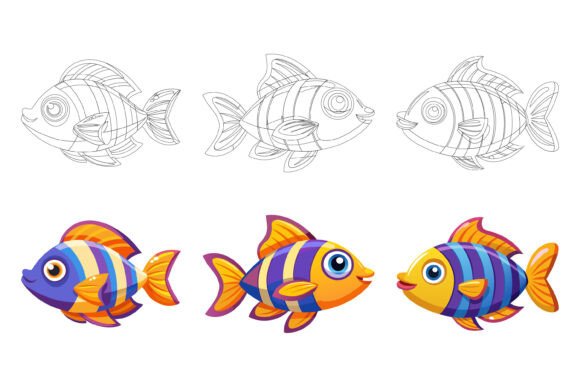
Colorful Fishes: Vibrant Vector Illustrations for All Users
Colorful fishes might sound like a simple theme, but when they come as a carefully crafted illustration set, they turn into a versatile visual tool. This particular collection is provided as an AI EPS pack, meaning you get fully editable vector artwork alongside a high‑resolution JPG preview. It is built to work smoothly whether you use a Mac or Windows machine, and the files are organized with a clean layer structure that saves time for both beginners and experienced designers. Rather than being just a set of pretty pictures, these fish icons and scenes offer precision, consistency, and the freedom to remix every element to fit your own project.
What Actually Comes in the Colorful Fishes Collection
The download includes three core file formats that cover most real‑world workflows. The AI (Adobe Illustrator) file is the master editable source, the EPS version provides cross‑software compatibility, and the JPG gives you an instant raster reference. Because the artwork is vector‑based, you can scale a tiny fish icon up to billboard size without losing sharpness. Every object is placed on separate, neatly named layers, so you do not have to hunt through hundreds of ungrouped paths. If you only need a single clownfish for an app icon, you isolate its layer and export it in seconds. If you want to recolor an entire school of tropical fish to match your brand palette, you can do that globally without starting from scratch.
The design itself prioritizes realism blended with a clean illustrative style. The creators focused on perfection in details and consistency, which means the fin shapes, scale patterns, and color gradients remain harmonious across all elements. This consistency is crucial when you use multiple illustrations in the same layout—a website, a printed poster, or an educational infographic. It avoids the mismatch that often happens when you combine clip art from different sources.
Why Different Users Care About This Type of Resource
A set of colorful fish illustrations might look like a niche asset, but its value changes depending on who you are and what you are trying to build. A small business owner creating a seafood restaurant menu will see it as a way to add charm without hiring an illustrator. A biology teacher preparing a worksheet about reef ecosystems will care about accuracy and the ability to label parts of the fish. A UI designer mocking up a fishing app will evaluate how well the symbols scale and whether the style feels modern enough. The same file works differently for each person because the underlying versatility is already there.
For someone just starting with graphic design, the attraction often boils down to ease of use. Opening an organized AI file and finding clearly labeled layers lowers the intimidation factor. A beginner can change a yellow tang’s body color by selecting a single shape and picking a new swatch, without needing advanced vector skills. Meanwhile, a seasoned illustrator might use the collection as a base to build a complex underwater scene, mixing the fish with their own coral drawings and saving hours of drafting time. Both paths are valid, and the file structure supports them equally.
Editing Made Straightforward, Not Overwhelming
One of the standout features mentioned right in the product description is how easy it is to edit, change colors, and modify the icons according to your needs. This matters more in practice than it sounds on paper. Many downloadable vectors come flattened or with stretched gradients that break when you try to recolor them. Here, the artwork is built with clean anchor points and separated highlight, shadow, and base color layers. If your project demands a monochrome icon set for a print brochure, you can knock all the colors out to shades of blue or gray in a few clicks. If you need a glowing neon fish for a night market flyer, you can tweak the gradients and add a soft glow effect without pixelating the edges. The ability to perform these edits quickly means you spend less time wrestling with files and more time refining your message.
Because the pack is explicitly designed for both Mac and Windows, you avoid the common headache of font or effect incompatibilities. The EPS format acts as a bridge if you use CorelDRAW, Affinity Designer, or older software. While the AI file offers the smoothest editing experience in Illustrator, the EPS ensures that non‑Adobe users are not locked out. The JPG serves as a quick drag‑and‑drop option for presentations, blog posts, or social media previews when you do not need a fully scalable graphic.
Contexts Where These Fish Illustrations Shine
It helps to think in terms of concrete projects because that is when the benefits of detail and flexibility become tangible. Here are a few realistic scenarios, each highlighting a different priority:
- Print materials – A diving center prints a large banner showing local reef fish. The vector quality ensures the banner stays crisp even when stretched across a 6‑foot display. The organized layers let the designer adjust the fin overlap to fit the copy space perfectly.
- Web and UI design – An app developer uses the fish icons as category symbols in a marine conservation app. The consistent stroke weights and style guarantee that the icons look like a family, not a random mishmash. The developer can export SVGs directly from the AI file and even tweak the line thickness for better readability at small sizes.
- Infographics and educational content – A science communicator builds a visual guide comparing fish adaptations. Because the illustrations are detailed and consistent, viewers can focus on the anatomical differences without getting distracted by stylistic inconsistencies. The ability to recolor the fish by species group adds a layer of visual coding that reinforces the data.
- Merchandise and product design – A hobbyist creates custom T‑shirt transfers for an aquarium club. The vector artwork can be separated into single‑color layers for screen printing, and the clean shapes make it easy to cut on a vinyl plotter. The same file can later become a sticker design or a mug wrap without quality loss.
Quality, Consistency, and Long‑Term Usefulness
When you buy or download an illustration set, you are investing time as much as money. A poorly organized file with broken paths can cost hours of frustration. That is why the emphasis on a neatly organized file and layer structure is not just marketing talk—it directly affects how many projects you can efficiently complete with the same resource. In educational settings, teachers can reuse the same fish illustrations across multiple lesson plans, adapting the colors for different age groups or printing black‑and‑white versions for coloring activities. A freelance marketer can use the graphics for one client’s seafood blog, then later recolor them for another client’s pet store newsletter, making the initial acquisition pay off repeatedly.
The detail consistency also holds up under scrutiny. If you place a close‑up of a fish next to a smaller version on the same page, the proportions and fin ray counts remain accurate. This might not matter for a casual birthday invitation, but it becomes critical for museum displays, scientific posters, or client presentations where credibility is attached to visual precision. The pack was evidently made with an understanding that a fish is not just a shape—it has a specific fin arrangement, eye placement, and body contour that, when rendered correctly, instantly elevates the feeling of quality.
Choosing This Set Based on Your Skill Level
If you have never opened Adobe Illustrator, you can still make great use of these assets. The included JPG files can be dropped into Canva, Word, or PowerPoint. With the EPS, many online vector editors can import the artwork, though you will lose access to the neat layer structure unless you use professional software. Starting with a well‑built file is actually a faster way to learn because you can see how professional layers are named and grouped. A curious beginner might open the AI file in a trial version of Illustrator, switch off visibility of one layer at a time, and begin to understand composition through reverse‑engineering. That learning value is an underrated bonus.
Advanced users will appreciate the time savings and the fact that the starting point is already refined. Instead of scanning a sketch or tracing a photo of a fish—which often results in clunky anchor points—you begin with artwork that already has smooth curves and balanced gradients. You can push the style further by adding your own textures, converting the fish into outline symbols, or using them as clipping masks for pattern fills. The flexibility supports both quick commercial work and highly creative personal projects.
Matching the Artwork to Your Specific Goals
Before using any illustration set, it helps to ask a few practical questions: Does this style align with the tone of my project? Will I need to edit the colors drastically, and if so, is the file built to allow that? Is the license suitable for my intended use—personal, commercial, or resale as part of a larger product? This colorful fishes pack leans toward a bright, semi‑realistic look that fits educational, lifestyle, and family‑oriented contexts well. If you are designing a corporate report on overfishing, you might desaturate the palette or use a subset of the less playful species. The fact that the artwork is editable puts that control in your hands.
For small business owners, speed and predictability are often the top metrics. Getting a menu, a sign, or a social post out without back‑and‑forth with a freelancer saves both money and stress. With an organized AI EPS pack, you can train a team member to swap out colors and resize elements following a simple guide, turning a one‑time purchase into a reusable brand tool. In that sense, these fish illustrations are not just decorations; they are mini design systems waiting to be adapted.
Practical Steps to Get Started
Once you download the collection, the first thing to do is open the AI file and glance at the Layers panel. You will likely see a root layer for each fish or group of fish, with sub‑layers for outlines, base colors, highlights, and shadows. This setup means you can quickly turn off the highlights to create a flat design look, or isolate the outline layer to create a coloring book page. Taking ten minutes to explore the structure will help you decide which assets to use for each task and prevent you from accidentally moving elements that should stay locked.
Because the pack is suitable for print, web, symbols, apps, and infographics, you can treat it as a universal fish library. Export a high‑resolution PNG for a blog header, save a scalable SVG for a responsive website, or create a set of Photoshop brushes by rasterizing a few fish shapes. The compatibility across output types means you are not forced into a single workflow. The JPG serves as a quick reference, but for any professional application, starting from the vector source is the smarter move.
This combination of detailed artwork, editability, and thoughtful file organization makes the collection a solid choice for a wide range of creative people. Whether your focus is on speed, educational clarity, commercial polish, or simply filling an aquarium‑themed project with life, you can grab the same files and make them work your way. The colorful fishes do not demand a certain skill level or a certain software subscription; they just ask that you have a clear idea of what you want to communicate and the willingness to adapt them accordingly.